

%20for%20Print%20%26%20Mailing.webp?alt=media&token=a9c84292-6487-4363-a17b-10393a3db086 "Mobile Card")
%20for%20Print%20%26%20Mailing.webp?alt=media&token=7e5917a4-25c6-4b37-bc7a-cd7247af021c "Desktop Card")
*2 mins read
Postcard Size Guide: Standard Dimensions (Inches, mm & Pixels) for Print & Mailing
Publish Date
July 24, 2026
Written by
Emily Chris Kieran
Opting for the right postcard size is more than just a little step in the designing process. This decision directly affects the print quality, postage costs, and how much impact your postal card has in the mailbox. A size chosen after great consideration can make your message easier to read, keep costs low, and help your piece stand out from regular mails.
The audience usually searches for postcard size, standard postcard size, what size is a postcard, postcard dimensions, and others of this sort. This is why in this blog, we will give a complete picture about all the postcard sizes in inches, mms, & pixels, and USPS rules in one place.
When you choose your size, you don’t have to go anywhere else to buy them. At ColorWing, we can create custom postcards in all sizes along with any arrangement of printing you prefer.
What Size Is a Postcard?
The standard size of a regular postcard in USA is 4" × 6" inches (102 × 152 mm). This is the most widely used size of post cards for direct mail, thank you cards, event invitations, and promos. Moreover, this size is best to balance cost, visibility, and mailing rules.
USPS also defines a narrower “postcard‑rate” window. To qualify for First‑Class postcard pricing, your piece must be:
At least 3.5" × 5" in inches
No more than 4.25" × 6" inches
Rectangular and within a specific thickness range.
That’s why the average and typical postcard size most people use is 4" × 6". This size of postal cards fits neatly inside these limits and qualifies for the lowest postcard postage.
Standard USPS Postcard Measurements
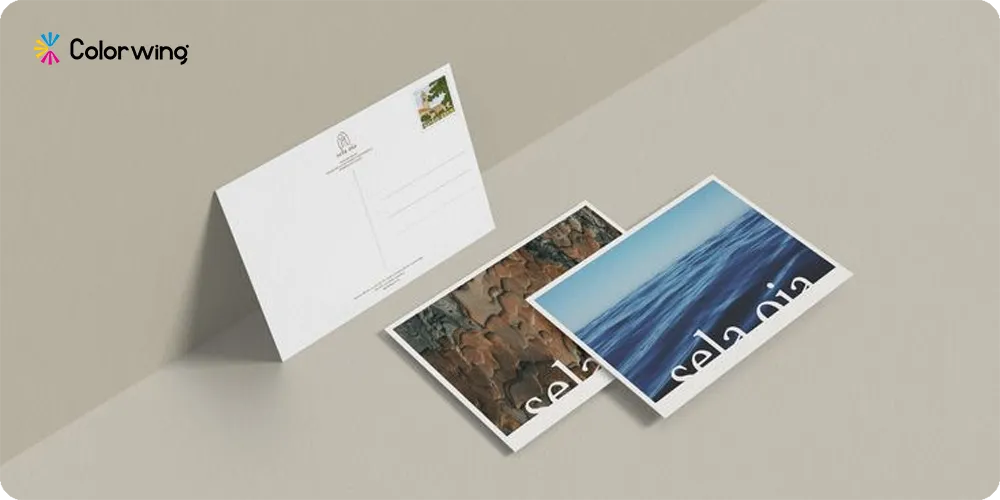
To keep your postcards affordable and mailable without surprises, focus on getting standard postcard measurements that fall inside the USPS postcard window. Anything outside this range is usually mailed as a letter or flat, which increases postage.
Type | Size in Inches ( H x W ) | Size in mm ( H x W ) | Notes |
Minimum postcard size | 3.5" × 5" | 89 × 127 mm | The smallest size for a postcard that USPS accepts for a postcard. |
Maximum postcard rate size | 4.25" × 6" | 108 × 152 mm | The postcard dimensions are acceptable but still billed at postcard rate. |
Typical “standard” postcard | 4" × 6" | 102 × 152 mm | Standard postcard size. |
USPS also requires these cards to be:
Rectangular, with straight or gently rounded corners.
At least 0.007" thick and no more than about 0.016" thick for postcard rate eligibility.
Finished so that the address and barcode area is clear and legible.
If your card is outside these standard postcard measurements, it’s typically treated as a letter or flat, which can raise your per‑piece postage significantly.
Common Postcard Sizes & What They’re Used For
Most printers and marketers work with a wider set of common postcard sizes than just the strict USPS postcard‑rate window. These formats are popular for direct mail, promos, art cards, and local campaigns.
Name / Use Case | Inches (H × W) | mm (H × W) | Typical USPS Class | Typical Use |
Small promo | 4.25" × 5.5" | 108 × 140 mm | Eligible to use as a postcard or letter. | Coupons, appointment cards, compact promotions. |
Standard postcard | 4" × 6" | 102 × 152 mm | Classic postcard rate size. | General mailers, thank‑you cards, simple offers. |
Larger standard / art | 5" × 7" | 127 × 178 mm | Usually letters; higher postage. | Photography, art prints, premium brand postcards. |
Mid‑size marketing | 5.5" × 8.5" | 140 × 216 mm | Letter/flat based on thickness. | Real estate, restaurant menus, multi‑offer promotions. |
Oversized mailer | 6" × 9" | 152 × 229 mm | Common oversized marketing class. | Stand‑out direct mail that needs more visual impact. |
Extra‑large mailer | 6" × 11" | 152 × 279 mm | Oversized and incurs higher postage. | EDDM‑style campaigns, big launches, highly visual campaigns. |
The right choice from these sizes of postcards depends on what you need to achieve:
You want to lower the postage as much as possible (4" × 6" works best for you).
If you are looking for more printable space to better show your design (5" × 7" and 5.5" × 8.5" are great options).
Want to make maximum impact in the mailbox (6" × 9" and 6" × 11" work best).
Postcard Dimensions in Pixels
Designers and printers look at postcard dimensions in different aspects. Printers work in inches and millimeters, while designers set up files in pixels. The standard resolution which must be kept at all times to ensure the images and text looks sharp is 300 DPI.
For the standard postcards, the pixels are set to 1200 x 1800 px. And just like this, the other options are also mentioned below:
Small promo = 1275 × 1650 px (Compact promo card)
Larger standard = 1500 × 2100 px (Popular for art & photography cards)
Mid-Size = 1650 × 2550 px (More room for offers and images)
Oversized Mailer = 1800 × 2700 px (Oversized marketing postcards)
Extra-Large Mailer = 1800 × 3300 px (Extra‑large mailers, strong visual impact)
When setting up your file:
Start with the exact postcard measurements in inches or mm.
Convert to pixels so your print ready file is of high resolution.
Add bleed (0.125" inches or 3 mm on each side) so your design looks perfect after the trimming process is done.
USPS Requirements for Postcards Apart from Sizes
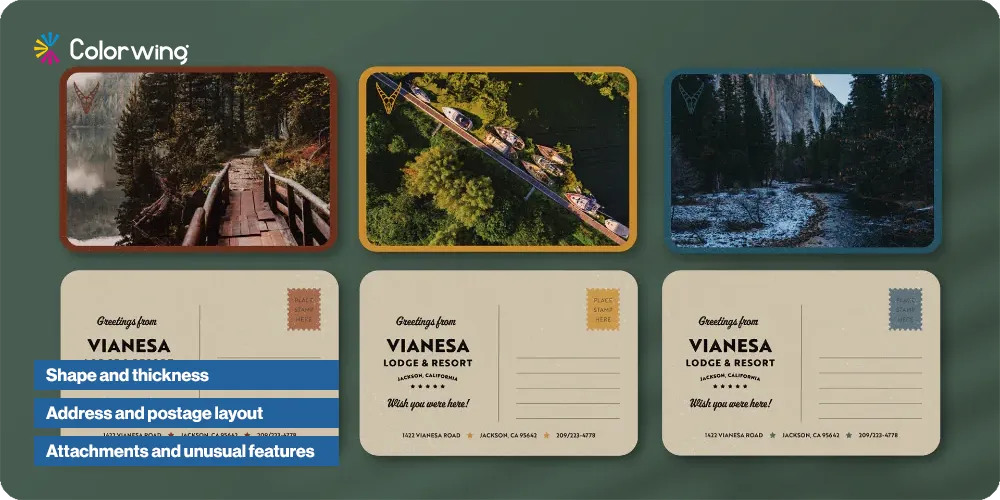
There are many other rules set by USPS even if you have sized your post card right. These standards can directly affect whether your piece smoothly qualifies for postcard rates or even for mails.
Shape and thickness
Postcards must be rectangular with consistent thickness throughout. Rounded corners are allowed if they’re gentle and uniform.
The eligible thickness for post-card rate is an estimated 0.007" to 0.016" inches. Thin cards might get damaged or rejected; thicker ones may be treated as flats.
Address and postage layout
The right half of the back of the card is usually reserved for delivery address, barcode, and postage details.
No heavy texts, graphics, or coatings should be in this area that could interfere with scanning and sorting.
Attachments and unusual features
Items like magnets, stickers, pop‑ups, or usually disqualify a postcard. Those pieces may be reclassified and charged at higher rates.
Understanding these requirements can help you to design custom postcards in right dimensions that not only look good but also print and mail without issues.
How to Choose the Right Postcard Size for Your Goal
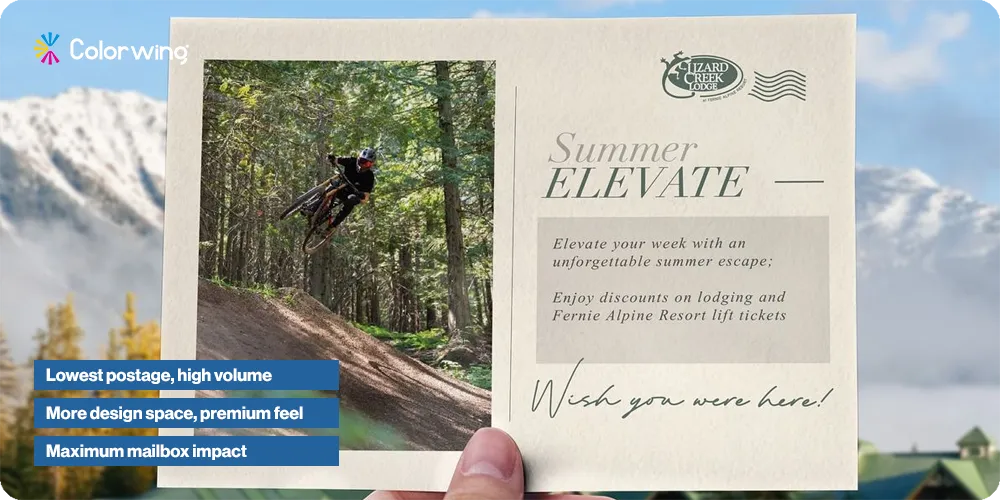
Think about your primary purpose: cost, design space, or impact in the mailbox. Then match that to a postcard size.
Lowest postage, high volume
Opt for a size that clearly qualifies for the USPS postcard rate, the most common one is 4" × 6".
Best to use for: appointment reminders, coupons, simple offers, and large volume mailings where every cent counts.
More design space, premium feel
Consider 5" × 7" or 5.5" × 8.5". These give you more room for images, multiple offers, and richer typography, but they usually mail at letter or flat rates.
Ideal for: photography cards, art prints, brand‑focused campaigns, and situations where the card itself is part of the experience.
Maximum mailbox impact
Go with oversized formats like 6" × 9" or 6" × 11". These stand out in the stack, but they come with higher postage and extra handling rules.
Ideal for: real estate, local business saturation, big product launches, or when you want note-worthy mailers.
No matter which size of postcard you go for, it must mirror your goal clearly. Whether it is for cost reduction, visibility, or creativity.
Design Tips That Depend on Postcard Size
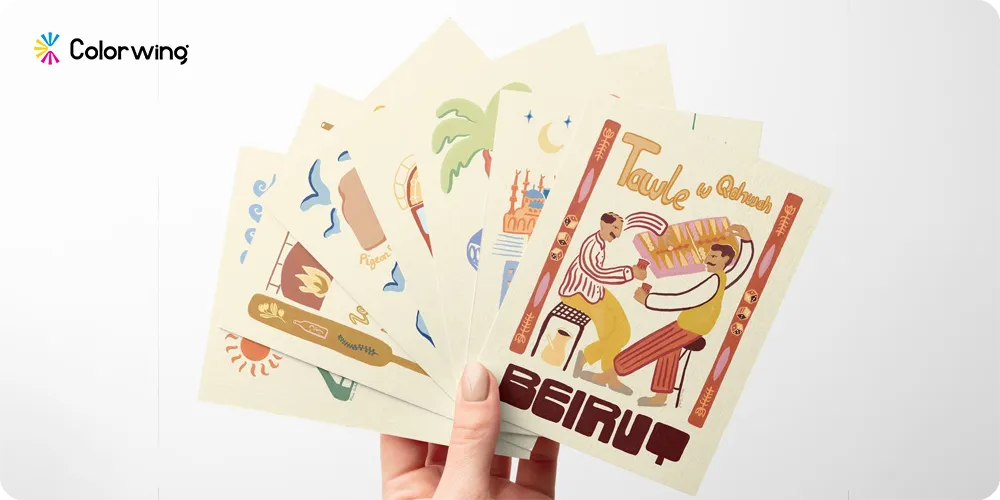
Smaller and larger postcard dimensions push you toward different design choices.
For 4" × 6" and 4.25" × 5.5"
Try to keep the layout as simple as possible. Go for one primary image, one dominant offer, and a single clear call‑to‑action.
Use large fonts and ample spacing so text remains readable at a small size.
For 5" × 7", 5.5" × 8.5", and 6" × 9"
Don’t compromise anything. Include the headline, image, and multiple offers on one card easily.
Reduce design clutters: Use white space so the card looks elegant.
For 6" × 11" and other extra‑large formats
Lean into bold visuals: large hero images, big headlines, and strong calls‑to‑action.
Use grid lines and sections so the card doesn’t look like a wall of text or images.
Across all sizes:
Keep important info and design elements away from the edges and keep inside the safe zone.
Use high‑contrast colors and fonts for legibility, particularly if your audience includes older readers.
Conclusion
Opting for the right size for postcards is not a guessing game anymore. It has become much more about matching the standard dimensions, USPS regulations, and your campaign goals. Ultimately, making your marketing paper card looks chic and mails at your expected price. Pre-determining the postcard dimensions from the start can result in better outcomes. Like you can avoid blurry images, postage surprises, and even layout problems.
In this blog, we have discussed in detail the relevant sizes for postcards in inches, mm, and pixels to let you make better choices. After you know which size option is best for your campaign, contact our experts here at ColorWing. They are ever ready to bring your design ideas to life in the form of exceptional looking custom postcards.
If you need design assistance, you can communicate your queries to us by dialing +1 (713) 832-0935.
FAQ
What is the standard postcard size?
The most common standard postcard size is 4" × 6". It’s the most widely used format for direct mail and general postcards because it fits USPS postcard rules and is cost‑effective to print.
What are common postcard sizes?
Common postcard sizes include 4" × 6", 4.25" × 5.5", 5" × 7", 5.5" × 8.5", 6" × 9", and 6" × 11". Each size serves different needs, from simple mailers to high‑impact direct mail pieces.
What pixel size should I use for a 4" × 6" postcard at 300 DPI?
For a 4" × 6" postcard at 300 DPI, set your canvas to 1200 × 1800 pixels, then add bleed (often 0.125" on each side) if your printer requires it.
Do oversized postcard sizes still qualify for postcard postage?
Larger sizes like 5" × 7", 5.5" × 8.5", 6" × 9", and 6" × 11" are usually mailed at letter or flat rates, not the cheaper postcard rate. They’re great for impact but cost more to send.

Emily Chris Kieran
Meet Emily Chris Kieran, a seasoned packaging industry writer with 7+ years of experience in the printing and packaging sector based in Texas. With a keen eye for color and a passion for data-driven insights, Emily crafts compelling content strategies that explore the intricacies of packaging and printing. She possesses in-depth knowledge of the industry's dynamics, staying up-to-date on the latest trends and technologies. When she's not delving into industry trends, you can find her unwinding on the golf course, where she finds inspiration and clarity. With a love for polo and a knack for storytelling, Emily brings a unique perspective to the world of packaging, illuminating fascinating facts and trends that inform and engage.